A Real Estate Development Pro Forma Is More Than a Spreadsheet
What is a pro forma?
The formal definition is fairly straightforward: it is a forward-looking financial model used to estimate how a project may perform. Fine. That is technically correct, but I do not think it is useful enough.
The way I look at it, a pro forma is our best attempt at putting numbers to the uncertainties of the development journey.
That distinction matters. If you treat the pro forma as a report, the objective becomes producing the right-looking answer. If you treat it as a planning tool, the objective becomes understanding what must be true for the project to work – and what could cause it to fail.
|
The spreadsheet is not the difficult part
You can build a pro forma in Excel. You can sketch one on a napkin. Increasingly, you can ask AI to help you create one. The tool is not really the point.
The difficult part is deciding what you are modelling, where the information comes from, and how much confidence you should place in each assumption.
A spreadsheet will calculate whatever you ask it to calculate. It does not know whether the proposed building can actually be approved. It does not know whether the units will be desirable. It does not know whether your construction estimate is based on gross floor area, gross construction area or rentable area. It does not know whether your lender will advance funds when your cash flow assumes they will arrive.
It will simply give you an answer – sometimes to two decimal places – and that can create a dangerous sense of precision.
From my perspective, acknowledged uncertainty is far more useful than false confidence. If the model tells us where we are uncertain, it is doing its job. If it hides uncertainty behind a polished return calculation, it may be making the decision worse.
Start with the decision, not the formula
Before opening the spreadsheet, ask a more basic question: what decision are we trying to make?
Are we deciding whether to pursue a site? Whether to spend more money on design? Whether to submit an application? Whether to refinance and hold the completed building? Whether to sell? Whether to bring in investors?
Those are different decisions. They require different information and different levels of confidence.
A preliminary model used to screen ten sites should not be confused with a model used to commit millions of dollars to construction. The first can live with broad assumptions. The second needs much more evidence behind buildability, costs, financing, timing and revenue.
So what does that mean? The model should become more detailed as the cost of being wrong increases.
A useful pro forma connects the entire development journey
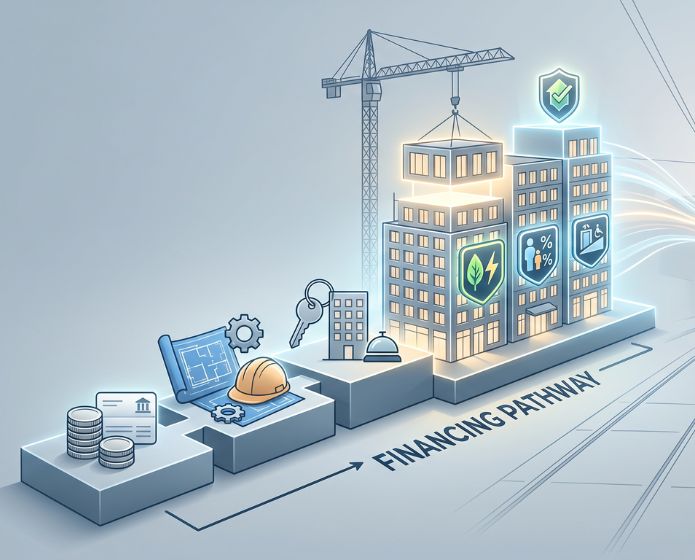
Development is not a single transaction. It is a sequence of decisions made over a long period of time, often with imperfect information. A useful model needs to connect at least five parts of that journey.
1. What can actually be built?
The model may assume a certain amount of sellable or rentable area, a particular unit count, parking arrangement, construction type or approvals pathway. Those assumptions must eventually reconcile with planning, zoning, building code, servicing, site constraints and design reality.
If the area, unit count or construction type changes, revenue and cost both change. That is why buildability cannot sit in a separate conversation from feasibility.
2. What will the completed product earn?
Revenue is not simply a rent-per-square-foot number or an assumed sale price. It comes from a particular product in a particular location for a particular customer or tenant.
Unit sizes, layouts, natural light, sound separation, parking, transit access, operating quality and the competitive market all affect what the building can realistically earn. If the product is weak, the pro forma cannot rescue it by increasing the rent assumption.
3. What will it truly cost – and how long will it take?
Construction is only one part of development cost. The model also needs to consider design and consultants, municipal charges, permits, utilities, taxes, financing fees, insurance, interest, escalation, leasing, stabilization and the cost of delay.
Time is not a separate line beside the pro forma. Time drives cost. Every month added to approvals, construction or lease-up can increase carrying costs and postpone the point at which the project begins generating stable income.
4. How will the project be funded through every stage?
This is one of the areas I see misunderstood most often. Maximum debt is not the same as minimum equity required.
A lender may be prepared to fund a percentage of eligible costs, but the owner still has to cover deposits, predevelopment expenses, lender exclusions, equity requirements, holdbacks, overruns and the time between submitting a draw and receiving the money.
The important question is not only, “How much can I borrow?” It is, “How much cash will I need, when will I need it, and what happens during the worst cash-flow month?”
Peak equity can be more important than the initial down payment. A project can appear financeable in total and still run out of money halfway through the journey.
5. How does the owner get out – or remain in?
The intended outcome affects decisions made from the beginning. A project built to sell is different from one built to refinance and hold. A long-term rental building needs to consider operations, turnover, durability and tenant experience in ways that may not appear in a simple construction budget.
The model should therefore connect development cost to the actual exit or operating strategy. It should show not only a headline return, but also how long the capital remains exposed, how much equity remains after refinancing, and whether the expected reward is acceptable for the risk being taken.
The model should be challenged, not admired
Once a base case works, the next reaction is often relief. The numbers pencil. Great. But that is when the more important work begins.
What happens if achievable revenue is lower? What if construction costs increase? What if approvals take longer? What if the interest rate or stabilized value moves in the wrong direction? What if more equity remains in the project after refinancing than expected?
Sensitivity analysis is not about randomly moving every cell. It is about identifying which assumptions have the greatest influence on the decision.
If a modest reduction in revenue eliminates the return, revenue is a critical risk. If a small delay creates a capital shortage, timing and liquidity are critical risks. If the project only works under the most optimistic exit value, that should be visible before more capital is committed.
A strong pro forma does not prove that a project will succeed. It shows what the project depends on.
The cost of learning too late
We recently met with an owner who had already spent years advancing a small development project. By the time they came to us, the conclusion was blunt: the pro forma no longer worked.
Important implications related to building classification, utility requirements and other project costs had not been fully anticipated early enough. The team had moved a long way down one path before the complete financial consequence of that path became clear.
The response was not to keep changing spreadsheet cells until the project looked profitable. It was to go back, reconsider the design and reduce the project to a version that had a better chance of working.
That is exactly what a pro forma should help us do earlier. It should help us understand the options, identify the thresholds and preserve enough runway to change direction before the project is trapped by decisions already made.
A pro forma is a living model
The report you produce today will probably be wrong by the time the project is complete. That is not an argument against modelling. It is the reason planning matters.
As the design develops, approvals become clearer, consultants provide advice, trade pricing arrives and financing terms are negotiated, assumptions should be replaced with better information. The pro forma should evolve with the project.
At each stage, I would ask: what changed, what did we learn, and does the project still meet the reason we started pursuing it?
The discipline is not in building the spreadsheet once. It is in returning to it every time a consequential assumption changes.
The goal is not certainty
No pro forma can eliminate uncertainty from a development project. That is not the standard.
The goal is to make the uncertainty visible enough that the owner, developer, investors and project team can make better decisions. What do we know? What are we assuming? What could hurt us? What needs to be verified next?
That is why I view development as a risk-management business. The pro forma is one of the tools we use to bring the risks, choices and financial consequences into the same conversation.
The numbers matter. But the thinking behind the numbers matters more.
|
See how the decisions come together inside a working model In the Toronto Multiplex Feasibility Workshop, we use a representative project to work through buildability, revenue, cost, financing, cash flow, peak equity, returns and downside scenarios. Although the case study is a multiplex, the planning discipline applies much more broadly to real estate development. Join the waiting list for the next workshop: multiplexworkshop.com |


Construction Innovation Checklist
This document is a supplementary resource to
episode #24 of the Real Estate Development
Insights Podcast in which Payam Noursalehi shares a practical framework for evaluating and selecting the most suitable innovative systems for your next project.